
Zagros Manuchar: Medya and Leyla
Medya and Leyla, an exhibition by Zagros Manuchar, presents portrait studies of two Kurdish women living in Finland through installation and experimental short film.
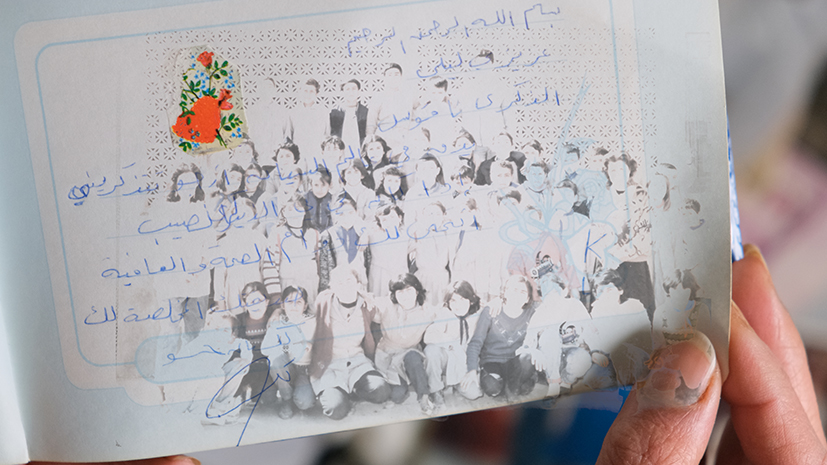
The exhibition features two experimental short films alongside childhood photographs, schoolbooks, and farewell letters from classmates belonging to Medya and Leyla. Through personal narrative, the exhibition reflects on childhood, displacement, refugee experience, memory, and longing for home.
Medya
Medya
2024, film, video, 9 min 34 s,
colour, stereo sound, 16:9, 4K.
Installation.
Zagros Manuchar’s Medya portrays a Kurdish woman of Syrian descent. This short film uses Medya’s real diaries, poems, and photographs to create a documentary narrative depicting her childhood games, memories, lost friends, schooling, and her neighbour’s children. It is a story of childhood, dreams, and aspirations amidst war and persecution.
War, trauma, and health issues persist in people for a long time, and those who have fled the war often have to undertake significant efforts to feel safe and achieve harmony with their bodies. Manuchar has also explored the experiences of Kurdish refugees in his work Whispers, featured in the exhibition Destination at the Lahti Museum of Visual Arts Malva. This work portrays three war refugees and their experiences and memories through photographs. Refugees often have to destroy their family photos for safety reasons when fleeing, and the few surviving pictures are precious to their owners.
The artist addresses the violence of war as well as the diverse experiences of women and children during wartime. Manuchar works closely with his subjects, incorporating their memories, youth poems, composed songs, family albums, and photographs into his pieces. It is important to him that the subjects are not merely portrayed as refugees whose traumas are displayed, but as independent agents and survivors who actively participate in constructing their portraits. Manuchar spent over a year conversing with Medya before filming to find a close and respectful approach to the portrayal. The work is personal for the artist, as he came to Finland as a UN war refugee at the age of four and was born in Iraqi Kurdistan.
Leyla
Leyla
2025, film, video, 11 min 30 s,
colour, stereo sound, 16:9, 4K.
Installation.
This is Leyla. I am Leyla. Here is Leyla.
Can you hear me — can you see me?
I left home at nine o’clock.
I left my friends in the night, my belongings behind.
I waited for my brother at the Jordanian border.
I finally got a fake passport.
I was on the move, detached.
(Extract from a youth poem written by Leyla)
Leyla is a kaleidoscopic short film and description about a Kurdish woman. It consists of Leyla’s childhood photos, farewell letters from friends, a smuggling story, thoughts about her Swedish support family and what it is like to be Leyla and finally be visible.
Artist Information:
Zagros Manuchar (b. 1990, Sulaymaniyah, Iraq)is the Finnish filmmaker and artist who has addressed themes of war and children’s rights in his cinematic works. He graduated with a Master’s Degree in Fine Arts from the Academy of Fine Arts at the University of the Arts Helsinki in 2022. Manuchar has held solo exhibitions and participated in group exhibitions in Finland, including the Nuoret 2023 exhibition at Kunsthalle Helsinki and the Destination exhibition in 2024 at Malva. His works have also been showcased at international film festivals, exhibitions, and cultural institutes. Additionally, he has published two children’s picture books together with author Leena Parkkinen: Syysvieras (Autumn Visitor), in 2023 and Käpykolon väkeä (The Folk of Pinecone Hollow) and Yllätysten talvi (Winter of Surprises) in 2024.
Acknowledgements:
The artist gratefully acknowledges the support of the Finnish Cultural Foundation, the Iraqi’ Women’s Association (Finland), Marja Baumgartner, Kristiina Koivunen, Kirsi Peltonen, Sanna Valtonen, Jorma Saarikko, Leena Parkkinen and Alma.
The exhibition and the artist’s work have also been supported by the Finnish Arts and Culture Agency, Oskar Öflunds Stiftelse and Kuvasto / VISEK.